Friday, March 29, 2019

Mass Wasting

Mass wasting: sometimes called mass movement or slope movement, is defined as the large movement of rock, soil, and debris downward due to the force of gravity. In other words, the earth's outer crust is being 'wasted' away on a 'massive' scale and falling to lower elevations.

Image result for landslides in costa rica


After a survey was taken throughout Costa Rica, it was determined that there are about 1,400 locations in Costa Rica that are prone to landslides. San José, the capital of Costa Rica, is a prominent location for landslides to occur. In 2010, there were 27 deaths due to landslides, in Costa Rica, 23 of these deaths happened in the capital, San Jose. 


There is no warning system in place, to help the people of Costa Rica determine if a possible landslide may occur in the area around them. It is important that citizens are aware of the potential of a landslide happening in their neighborhood, by watching how much rain falls in their area. It is also important to see if you are in an area that is known for having landslides in the past. 

Resources:
https://study.com/academy/lesson/mass-wasting-definition-types-causes-processes.html
https://www.welovecostarica.com/costa-rica-landslides-watch-out/
https://www.worldnomads.com/travel-safety/central-america/costa-rica/costa-rica-natural-dangers

Friday, March 1, 2019

Volcanoes

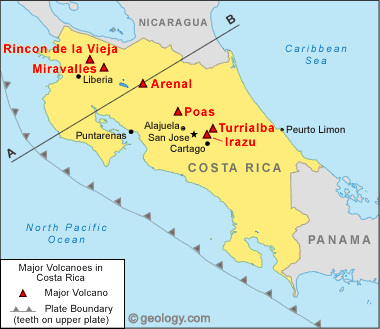
Due to Costa Rica's close proximity to a tectonic plate boundary, the county has several major volcanoes that have formed throughout the country. Costa Rica is home to six active volcanoes, as well as sixty-one dormant or extict volcanoes. Costa Rica's volcano, Arenal, is one the most notible volcaones of the country. Arenal was one of the most active, in the country, until it entered a resting phase in 2010. The Poas volcano remains one of the most active volcano, but it was not had a major eruption since 1910. These volcaones and many others located in Costa Rica, have become major tourist attractions in Costa Rica. 
Related imageTo keep citizens safe from a possible volcanic eruption, Costa Rica may shut down a national park where a volcano is located. In May of 2018, the Poas Volcano Natioanal Park was closed due to safety reasons, and this has also happened at the Turrialba National Park as well. Costa Rica does not use an early warning system, when it comes to possible eruptions of these volcanoes. It seems like the  only safety measure they take is to shut down the park and to try and keep as many people as possible away from the danger. 
References

https://www.arenal.net/volcanoes-costa-rica

https://news.co.cr/tourists-and-businesses-impatient-for-poas-volcano-national-park-in-costa-rica-to-reopen/73127/

Friday, February 15, 2019

Earthquakes

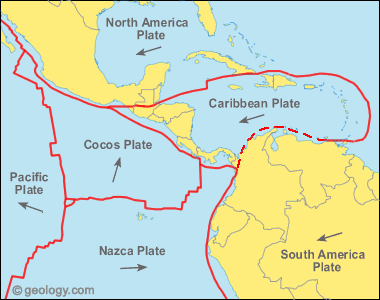
Just off the coast of the South-West boarder of Costa Rica, in the Pacific Ocean, is where the Cocos Plate is subducting under the Caribbean Plate. Due to the location of these tectonic plates, it is this area of Costa Rica that experiences the most earthquakes. Accoriding to the IRIS monitoring website, the most recent earthquake to take place in Costa Rica happened on Febuary 13, and it had a 4.5 magnitude.  In the area surrounding San José, Costa Rica's capital, there is the most potential for a higher magnitude earthquake. Even though this are of COsta Rica has the highest potential to experience the most damage, the entire country has a high change of experiencing earthquakes.

Related image

Due to the frecuency of earthquakes in Costa Rica, they have new policies to reduce the damage to the people and tourist of Costa Rica. They have began to build structures to "prevent" them from collapsing in the event of an earthquake, as well as not instulling natural gas lines, to prevent unnecessary fires. The building that are not having natural gas lines installed are mostly tourist destinations. In July of 2018, it was reported that Costa Rica was doing trial runs of implementing an Earthquake Early Warning System. This would allow any citizen with a smartphone ot recieve alerts, when an earthquake could erupt.


References:
https://www.delapuravida.com/2011/powerful-6-0-friday-the-13th-earthquake-in-costa-rica/
http://ds.iris.edu/seismon/zoom/index.phtml?rgn=Central_America
https://costa-rica-guide.com/travel/health-safety/natural-disasters/
https://news.co.cr/costa-rica-could-soon-have-an-earthquake-early-warning-system/74618/

Friday, February 8, 2019

Tectonic Plates

location map for Arenal volcano

Costa Rica is located on the overlapping area of the Cocos Tectonic Plate and the Caribbean Plate, which created a convergent boundary. Due to the Cocos Plate moving under the Caribbean Plate, it has resulted in the formation of a volcanic arc in Costa Rica. The subduction zone in Costa Rica is the cause of the volcanic arc, that is shown in the picture to the left. Another effect of these plates is earthquakes, which Costa Rica can experience many earthquakes a year. In 2018, over 200 earthquakes with a magnitude of 3.8 or higher, was recorded in Costa Rica. 


Plate tectonics of Arenal volcano


The south-west area of Costa Rica is located near the border of the two tectonic plates. These colliding plates are known as a convergent boundary. The types of plates that are colliding are ocean-continent plates, which means the Cocos Plate is moving under the Caribbean Plate. This type of plate boundary often is the cause of volcanic formation, earthquakes, tsunamis, and flooding.


References:
https://geology.com/volcanoes/arenal/
https://www.volcanodiscovery.com/earthquakes/costarica/archive/2018.html
Keller, Edward A., and Duane Edward DeVecchio. Natural Hazards. 4th ed., Pearson Education,
       2014.

Sunday, February 3, 2019

Natural Hazards: A natural hazard is defined as an extreme event that occurs naturally and causes harm to humans or to other things that we care about. Natural hazards that are common in Costa Rica include flooding, volcanic activity, and earthquakes.

Image result for costa rica after an earthquake


Natural Disasters: A natural disaster is defined as a sudden and terrible event in nature (such as a hurricane, tornado, or flood) that usually results in serious damage and many deaths. Some of the most common natural disasters occurring in Costa Rica are flooding and hurricanes. 

Image result for costa rica after hurricane


Catastrophe: A catastrophe is defined as a momentous tragic event ranging from extreme misfortune to utter overthrow or ruin.